

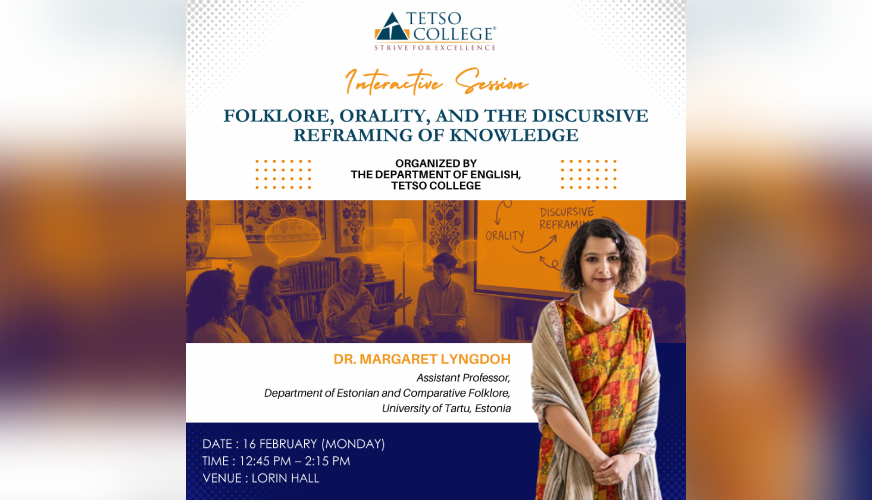
Resource Person: Bio-note
Dr Margaret Lyngdoh received her PhD in 2016 from the University of Tartu, Estonia. She was the Albert Lord Fellow (2016) at the Centre for Studies in Oral Tradition, University of Missouri, and was awarded the Estonian Research Council Postdoctoral Fellowship for her research project from 2018 to 2021. She served as the Editor of the Journal of the International Society for Folk Narrative Research (ISFNR) from 2019 to 2022.
Dr Lyngdoh is currently a researcher at the Department of Estonian and Comparative Folklore. She has published extensively in international peer-reviewed journals and contributed to several edited volumes. Her current research focuses on developing an Indigenous religious research methodology aimed at fostering equitable and ethical collaboration between academic researchers and Indigenous communities.
Concept Note
In the absence of a written script, the only genres that existed in the corpus of oral texts excluded the prose genre. This meant that, the written genres that mark literary disciplines and aesthetic pursuits came into existence alongside a written script. If we exclude the scripted text, we are left with the verbal forms and the particularities that mark generic forms among cultures that recently incorporated writing. In this backdrop then, globalization matters! Among highly impacted tribes, like the tribes in Northeast India, there is a rapid loss of oral verbal forms of ritual texts that are the most affected.
However, the versatility of the common oral forms firstly ensured adaptation to change and thus have survived in the face of the large-scale production of written texts. Written texts among Khasi, have greater influence than oral types because of the dominance of the Bible which is considered the paramount manifestation of the script. Cultures that originally were oral, until the last 150 years or so like the Karbi,
and the Khasi however, still own high forms of verbal art that include different registers of speaking. Ktien kñia among Khasi and lamlir among Karbi are the ritual registers of language. The ritual register comprises the high form of language that may include style markers like reduplication, repetition, and vocalisation of melody that does not include words.
This talk will focus on the nature of orality and oral forms and try to show how the discursive reframing of what is oral into the written media, has led to the reorientation of how personhood is constructed. Through case studies will show how knowledge is now the prerogative of culture, with the other than human world being relegated to the peripheries.