

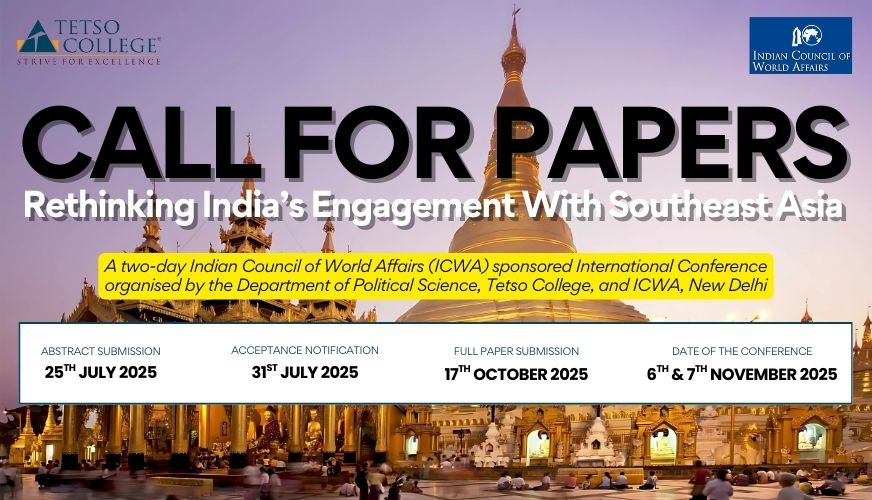
A Two-day Indian Council of World Affairs (ICWA) sponsored International Conference organised by the Department of Political Science, Tetso College, and ICWA, New Delhi
Important dates:
Abstract Submission: 25th July 2025
Acceptance Notification: 31st July 2025
Full Paper Submission: 17th October 2025
Date of Conference: 6th & 7th November 2025
Registration Link: bit.ly/ICWATetsoReg
Payment Link: bit.ly/ICWATetsoPay
Rethinking India's Engagement With Southeast Asia
Submission Guidelines
Abstract: 150-300 words (must include five keywords)
Abstract submission: 25 July, 2025
Acceptance Notification: 31 July, 2025
Full papers: 6000 - 7000 words
Deadline for full paper submission: 17 October, 2025
Email ID for submission: polscienceseminar@tetsocollege.edu.in
Contact number for queries: +91 70858 95726
Conference date: 6 - 7 November 2025
About Us
As a rising major power in the 21st century, India is in a position to play a pivotal role in international affairs. The emerging isolationist tendencies of the United States, coupled with the dilemmas of the European Union, Japan, and South Korea over their longstanding dependence on the United States for defence, are pushing India to take a much greater and decisive role in the world. India has long remained a symbol of peace and non-alignment, engaging with and building relationships with all sides. This has also made many countries in the world view India in a positive light. However, with evolving vicissitudes in the current international relations, India now has to strengthen and deepen its existing relationships with other countries. This is especially relevant for New Delhi’s relationship with its Southeast Asian neighbours. This particular region of the world is of vital importance because of the complex geopolitical factors at play. Given its proximity to South Asia and the Indo-Pacific region, Southeast Asia is central to India’s rise as a great power in world affairs.
Apart from geopolitical considerations, this region is also crucial for economic and strategic reasons. India’s trade with this region, particularly with the Association of Southeast Asian Nations (ASEAN) member states, is expected to increase from $96.79 billion in 2018-2019 to approximately $300 billion by 2025. In terms of strategic ties, New Delhi has deepened its strategic engagement with Singapore, Vietnam, and Indonesia, among many others in this region. Such geopolitical, economic, and strategic engagements have been founded upon cultural and historical ties between India and this region that date back to ancient times—the flow of Buddhism, Sanskrit, and Hinduism eastward, for instance, are examples of such deep-rooted cultural, historical, and people-to-people exchanges and ties.
Keeping these things in mind, the proposed international conference aims to re-contextualise present India’s foreign policy initiatives, such as the Act East Policy, Indo-Pacific tilt, India’s Neighbourhood First Policy, and BIMSTEC, to the shifting centres of power from unipolarity to multipolarity. This rethinking and recontextualising is an essential prerequisite to understanding and better formulating India’s foreign policy, in general, by deliberating on how such shifts in the centres of power alter the very nature of New Delhi’s existing foreign policy stance, in general. As India enters the great game of power politics, Southeast Asia becomes the first crucial step through which to announce its arrival as a great regional power. The question is whether India is ready to accept such a momentous task.
With this in mind, the Department of Political Science, Tetso College, in collaboration with the Indian Council of World Affairs (ICWA), New Delhi, is organising a two-day international conference on the 6th and 7th of November 2025. The international conference’s key focus will be on India’s foreign policies (especially concerning the Southeast Asian region), Diplomacy, historical linkages, cultural and civilizational associations, Geopolitics, China, Cross-border issues, and the Myanmar civil conflict and its implications on India.
The conference invites scholars, researchers, policymakers, and practitioners to submit their original and unpublished papers for consideration on any one of, but not limited to, the following thematic areas:
- Revisiting India’s Act East Policy—Rhetorics and Realities
- Shifting Strategies—From Southeast Asia to the Indo-Pacific
- Prospects and Challenges in India-ASEAN Partnership
- Prospects and Challenges in India-ASEAN Partnership
- Diplomacy and Foreign Policy
- Historical Relationships and Interconnections
- Military Strategy and Ethos
- Neighbourhood First Policy—Successes and Failures
- Sub-regional Initiatives and Impact on India’s Regional Standing
- Evolving Geopolitical Scenarios and Role of “Rising China”
- Leveraging Ethnic, Cultural and Civilizational Linkages
- Emerging Cross-border Issues and the Myanmar Coup Crisis
ABOUT THE KEYNOTE SPEAKER
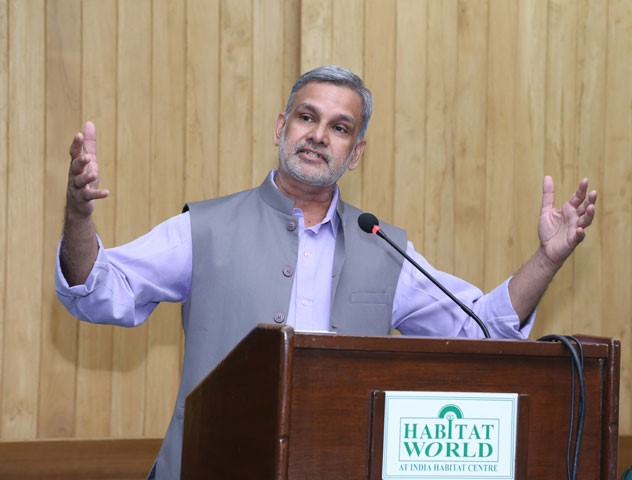
Professor Chintamani Mahapatra is the Founder and Honorary Chairman of Kalinga Institute of Indo-Pacific Studies. He is the Editor of India Quarterly, a reputed journal on Indian foreign policy, and the Editor of Indian Foreign Affairs Journal (published by the Association of Indian Diplomats). He is also a Visiting Professor at Impact and Policy Research Institute (IMPRI), New Delhi.
Professor Mahapatra was formerly a faculty at the School of International Studies of JNU, from May 1999 till May 2022. He served as Rector (Pro-Vice Chancellor) of Jawaharlal Nehru University from 1 March 2016 till 7 February 2022. Notably, he held the prestigious Tagore Chair Professorship at Yunnan University of China, showcasing his international standing.
Professor Mahapatra’s influence extends beyond academia, as evidenced by his roles on significant committees and editorial boards. He has contributed his expertise as a Member of the UGC Review Committee for the Area Studies Programme, the Fellowship Expert Committee at ICSSR, and the Editorial Board of Strategic Analysis at IDSA. His research pursuits have taken him to renowned repositories, including various US Presidential Libraries such as the Truman Library, Eisenhower Library, John F. Kennedy Library, and Johnson Library.
Additionally, he has delved into archives at the US National Archives in Washington, DC, and the British Public Record Office in London.
Professor Mahapatra has authored/edited 8 books, and has contributed chapters to above 30 edited books. He has published above 70 research articles in reputed journals. He has been awarded a number of international fellowships, such as Fulbright Fellowship, Commonwealth Fellowship, and Visiting Fellowships to undertake research in the US, UK, Austria, Australia and many other countries. He has been a visiting faculty in several UGC-run Academic Staff Colleges, the Foreign Service Institute of the Ministry of External Affairs, National Defense College, Army War College, Naval War College and the College of Air Warfare. He is also a regular commentator in newspapers and on audio-visual media on international affairs.
SEMINAR EXECUTIVE COMMITTEE
CONVENOR
Dr. Salikyu Sangtam, Associate Professor, Department of Political Science
ADVISOR
Dr. Anjan K Behera Dean (School of Political Studies) IQAC Coordinator
MEMBERS
Khriezonuo Kire, Department Coordinator, (Asst. Professor, Political Science)
Dr. Daniel Michal Khan, (Asst. Professor, Political Science)
Dr. C.V. Lalmalsawmi, (Asst. Professor, Political Science)
Dr. P. Lalpekhlui, (Asst. Professor, Political Science)
Thepuzo Keyho, (Asst. Professor, Political Science)
Lopilo Humtsoe, (Asst. Professor, Political Science)