
Intranet

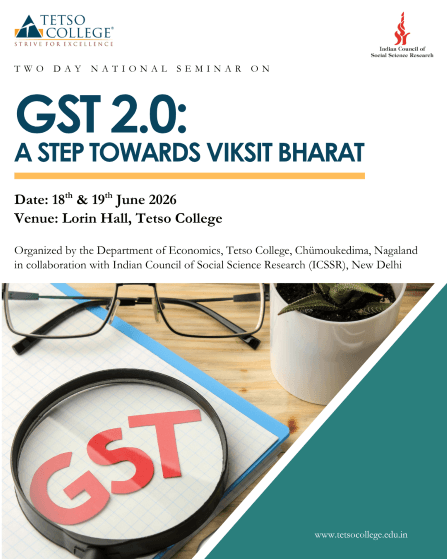
Organized by the Department of Economics, Tetso College, Chümoukedima, Nagaland in collaboration with Indian Council of Social Science Research (ICSSR), New Delhi, will host a Two-Day National Seminar on “GST 2.0: A Step Towards Viksit Bharat”.
Be part of the conversation shaping India’s economic future.
Concept Note
Viksit Bharat 2047 is the Government of India’s long-term vision to transform India into a developed nation by the centennial year of independence in 2047. A developed India is envisioned not only in terms of high GDP and per-capita income but also through advances in human development, technological progress, social equity, environmental sustainability, and strong governance. The main objective of Viksit Bharat 2047 seeks to build a prosperous, self-reliant, inclusive, and globally influential India. The key targets to be achieved are GDP of USD 30–40 trillion by 2047, increase Per capita income of USD 15,000–18,000, zero poverty and universal access to quality healthcare and education.
In order to achieve the objectives of Viksit Bharat NITI Aayog leads the strategic planning through the “Vision Viksit Bharat @2047” approach paper and Key national programs- Make in India, Aatmanirbhar Bharat, Digital India, Skill India, Gati Shakti, and NEP 2020 form the backbone of implementation.
The economic requirements to achieve the targets of USD 23-40 trillion demands 7- 10 percent annual GDP growth for two decades and high growth rate in the manufacturing, services sectors and strengthening exports.
The Goods and Services Tax (GST) is a comprehensive, destination-based indirect tax system implemented in India on 1 July 2017 no doubt simplified India's indirect tax structure, reducing tax cascading (tax on tax), creating a unified national market, and increasing transparency, enhanced Ease of Doing Business in India, widened tax base, reduced logistics costs and helped in formalization of the economy, boost revenue collection and uniform pricing across states in the country had some drawbacks such as high compliance burden, complex multi-rate structure, frequent changes in rules, increased costs for small businesses and not fully “One Nation, One Tax. ”
As India envisaged Viksit Bharat 2047, the need was felt to reform the GST structure in the country. So, Prime Minister Narendra Modi in his Independence Day address from the iconic Red Fort on August 15, 2025 announced a major tax reform: “The government will bring NextGeneration Goods and Services Tax (GST) reforms, which will bring down the tax burden on the common man. ”
Carrying this forward, Finance Minister Nirmala Sitharaman unveiled sweeping 1 changes in early September. The multi-tier GST system—earlier spread across four slabs of 5%, 12%, 18% and 28%, has now been streamlined into just two: 5% and 18%.
The new structure comes into effect from September 22, 2025 and promises direct benefits to the common man, small and medium enterprises, labour intensive industries, farmers and agricultural sectors. GST 2.0 is needed to make India’s tax system simpler, more efficient, and business-friendly. A stronger GST version is essential to streamline return filing, simplify input tax credit rules, and improve the technology platform to reduce glitches. GST 2.0 should also bring excluded items like petroleum and electricity under the tax framework to achieve true “One Nation, One Tax. ”
Overall, GST 2.0 aims to create a more transparent, stable, and predictable tax system that supports economic growth and reduces the challenges faced by taxpayers.
The proposed seminar will enhance the understanding of GST 2.0 Reforms, create awareness of Government Vision for Viksit Bharat. Participants will learn about key changes introduced in GST 2.0 and discuss how GST 2.0 aligns with India’s vision for Viksit Bharat by 2047. Also the seminar shall bring together different stakeholder i.e, industry, government, practitioners, and academia together and brainstorm on the issues pertaining to GST 2.0 and its implementation. By the end of the seminar participants would be more informed about India’s long term development vision.
Sub Themes
For Detailed Guidelines and Submission CLICK HERE
Copyright © . All Rights Reserved.
Tetso College provides a variety of scholarships and need based assistance for students. This aligns to our mission and vision to empower people towards lifelong excellence and to create a positive impact in the world. we recognise excellence in sports, academics and societal impact.
