
Intranet

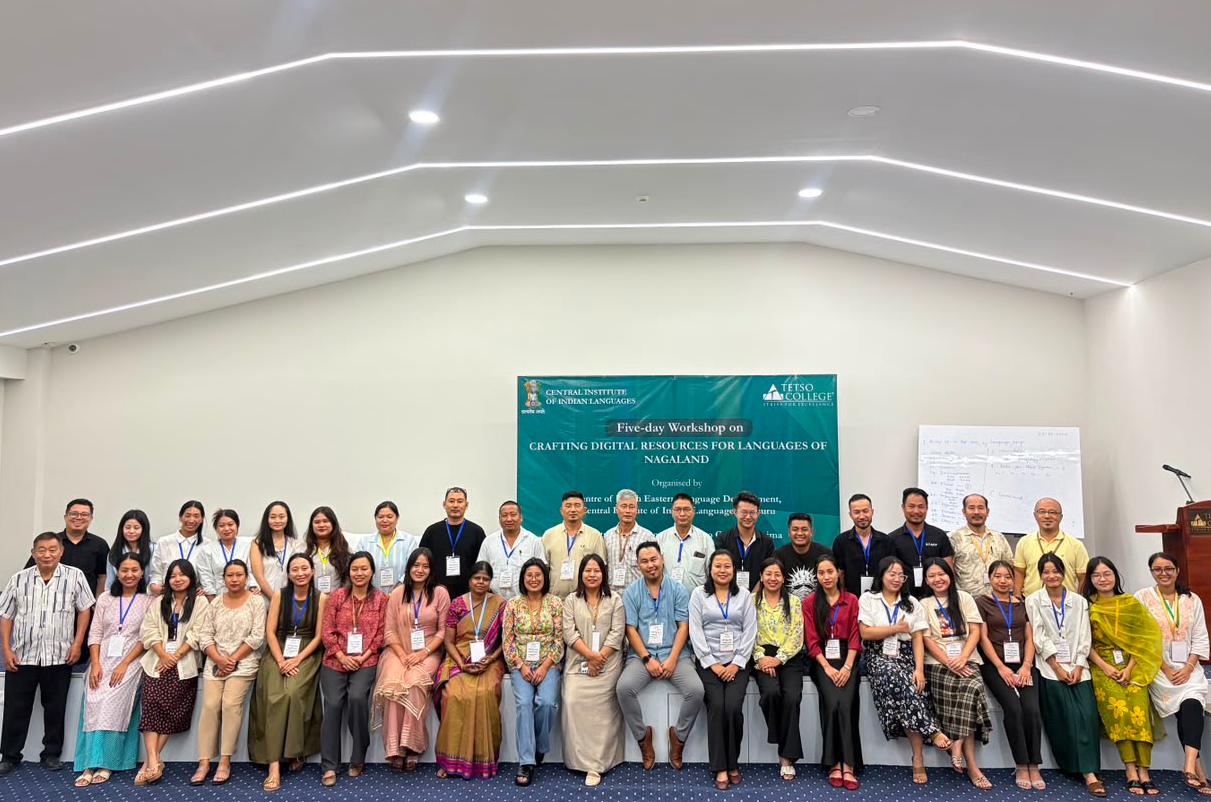
The five-day workshop on “Crafting Digital Resources for the Languages of Nagaland”, organised by the Central Institute of Indian Languages (CIIL), Mysuru, in collaboration with the Department of Linguistics, Tetso College, Sovima, successfully concluded on 22 August 2026. Held from 18–22 August 2026, the workshop brought together linguists, language experts, community resource persons and native speakers to explore practical ways of developing digital resources for the Indigenous languages of Nagaland.
The workshop focused on collecting, organising, documenting and transforming community-based language data into useful digital resources. As a preliminary batch, 12 languages of Nagaland were randomly selected for the workshop: Angami, Ao, Khezha, Khiamniungan, Konyak, Lotha, Phom, Rengma, Sangtam, Sumi, Tikhir and Zeme. Representatives of these languages worked together with linguists and technical resource persons to develop and test prototype digital resources for language learning and community use.
Through a combination of linguistic training, data collection, audio recording, transcription, verification and digital-resource development, the workshop demonstrated how community language knowledge can be transformed into accessible and engaging digital learning materials.
A Working Prototype of the Nagaland Language Digital Hub
One of the major outcomes of the workshop was the development of a working prototype of the Nagaland Language Digital Hub, using language data collected from the participating communities. The prototype demonstrates how the language data collected from the 12 participating languages can be transformed into interactive and engaging digital learning activities online. Rather than remaining as static wordlists or recordings, the collected language materials are incorporated into digital games and activities that allow learners to interact with the languages in different ways.
The prototype currently includes 13 digital language-learning games and activities:
The games are designed for learners at different levels, ranging from children and teenagers to adults and heritage-language learners. They demonstrate how the language resources collected during the workshop can be put to practical use through digital tools that are interactive, engaging and potentially accessible to a wider community of learners.
Prototype Demonstrated at the Valedictory Programme
The working prototype of the Nagaland Language Digital Hub was formally demonstrated during the valedictory programme on 22 August 2026. The demonstration was conducted by the technical expert involved in the workshop and showcased how the language data collected from the participating communities had been transformed into interactive digital learning activities. The demonstration was held in the presence of Dr. Hewasa L. Khing, Principal, Tetso College, along with the workshop participants, resource persons and other members of the organising team. The demonstration provided an opportunity for those present to see how the prototype functions and how community-generated language materials can be integrated into digital tools for language learning.
A Model for Other Languages of Northeast India
The prototype developed during the workshop is intended not only as a resource for the participating languages but also as a working model for the development of digital resources for other Indigenous languages of Northeast India.
As the 12 languages were selected as a preliminary and randomly selected batch, the present prototype will be further reviewed, tested and refined. Once the model is confirmed and finalised, the methodology, framework and digital activities developed through this initiative can be adapted and extended to other languages across Northeast India.
This approach will allow the experience gained from the preliminary batch to inform the development of resources for a much larger number of languages, while allowing appropriate linguistic and community-specific adaptations for each language.
From Community Language Data to Digital Learning
A central principle of the workshop was that the development of digital language resources should be rooted in the knowledge and participation of the language communities themselves. Native speakers and community resource persons therefore played an important role in providing, recording and verifying the language data used in developing the prototype.
The workshop demonstrated a collaborative model in which community knowledge, linguistic expertise and digital technology can work together to create meaningful resources for Indigenous languages. The prototype of the Nagaland Language Digital Hub provides a practical example of how language documentation can move beyond data collection towards the creation of resources that communities can actually use for learning and engagement.
The successful completion of the workshop therefore marks not merely the conclusion of a five-day programme, but an important step in a continuing process of digital language-resource development. The next phase of work is planned for February 2027, when the prototype and the resources developed during this preliminary phase will be further reviewed, refined and developed. The organisers expressed their appreciation to all the participating community resource persons, native speakers, linguists, technical resource persons and collaborators whose contributions made the workshop and the development of the prototype possible.
The initiative represents an important step towards language documentation, digital inclusion, language learning and the promotion of the rich linguistic diversity of Nagaland and Northeast India, while demonstrating the possibilities of using digital technology to support Indigenous languages in contemporary educational and community contexts.
Copyright © . All Rights Reserved.
Tetso College provides a variety of scholarships and need based assistance for students. This aligns to our mission and vision to empower people towards lifelong excellence and to create a positive impact in the world. we recognise excellence in sports, academics and societal impact.
